

Signature Rooms
Vastu for Home Interiors: A Practical Room-by-Room Guide
Place the kitchen in the south-east, the pooja space in the north-east, the master bedroom in the south-west, and keep the main door well-lit and unobstructed — those four moves cover most of practical vastu. When your flat's layout conflicts, colour, orientation and zoning remedies do the job without breaking a single wall.
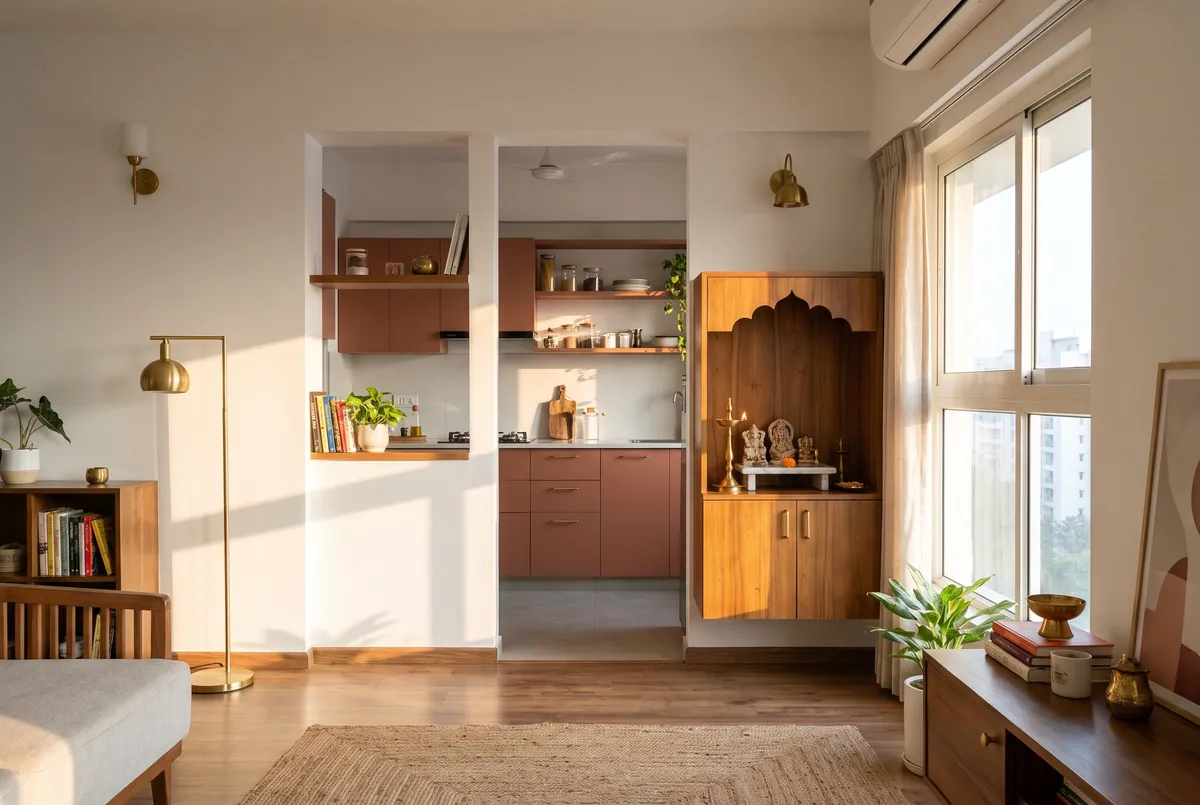
Does vastu still work in a modern Bengaluru flat?
Quick answer
Yes, when treated as zoning logic rather than a rulebook — much of vastu shastra responds to the Indian sun path. A Bengaluru apartment gives you a fixed shell, so control what sits inside it: hob position, which wall the bed touches, mandir placement and zone colours.
Yes — if you treat it as a zoning logic rather than a rulebook. Strip away the mysticism and vastu shastra is largely a response to the Indian sun path: cool morning light from the north-east, harsh afternoon heat in the south-west, and prevailing south-west monsoon winds. Placing the pooja space where morning light falls and the master bedroom where thick evening walls keep heat out is simply good passive design that happens to be two thousand years old.
The practical problem is that a Bengaluru apartment gives you a fixed shell. You cannot move the kitchen's plumbing shaft or rotate the entrance. What you can control is everything inside: where the hob sits, which wall the bed touches, where the mandir hangs, and what colours anchor each zone.
That is the approach this guide takes. Four placements do most of the work — kitchen, pooja, master bedroom, main door — and every one of them has an accepted remedy when the floor plan refuses to cooperate. No demolition, no dogma.
Which is the correct kitchen vastu direction?
Quick answer
South-east, the Agni corner, is the classical kitchen vastu direction, with north-west as the accepted second choice. Place the hob in the south-east corner so the cook faces east, keep the sink towards the north-east, and leave at least a 600 mm gap between hob and sink.
South-east is the classical kitchen vastu direction — the Agni, or fire, corner — with north-west as the accepted second choice. Within the kitchen itself, place the hob in the south-east corner so the cook faces east, and keep the sink and water purifier towards the north-east of the counter. That fire-water separation is the rule most vastu consultants actually check, and a minimum 600 mm gap between hob and sink satisfies both vastu and basic kitchen safety.
If your flat puts the kitchen in the north or north-east — common in compact 2BHK plans — relocation is rarely realistic, because the plumbing and exhaust shafts are structural. The working remedy is internal correction: push the hob to the south-east corner of whatever room you have, face east while cooking, and warm the palette with terracotta, ochre or wine tones.
None of this changes the budget. A Bengaluru modular kitchen typically runs ₹1.8–8 lakh excluding 18% GST, whichever corner it occupies.
Where should the pooja room go?
Quick answer
North-east — the Ishanya corner — with the person praying facing east or north, and idols on a plinth raised 750–900 mm off the floor. Avoid a shrine under a staircase or against a toilet wall; if the north-east is a bathroom, shift to due east.
North-east — the Ishanya corner — is the pooja room vastu direction, and you should face east or north while praying. In a full-size pooja room, keep idols on a plinth raised 750–900 mm off the floor for seated prayer, never resting directly on the ground, and light the space warm (around 2700K) rather than stark white.
Most Bengaluru flats have no spare room in the north-east, and that is fine: vastu accepts a dedicated corner over a dedicated room. A wall-mounted pooja unit on the east wall of the living room, or in the north-east corner of the dining area, is a fully legitimate placement. What to avoid is firmer: never under a staircase, never sharing a wall with a toilet, and not inside the master bedroom if you can help it — and if you cannot, screen it with a shutter or curtain when not in use.
If the north-east zone of your flat is a bathroom, shift the pooja to due east and let it go. A serene, well-kept corner in the east beats a compromised one in the north-east.
What are the bedroom vastu tips that actually matter?
Quick answer
The master bedroom belongs in the south-west, and you should sleep with your head to the south or east, never north. Keep the bed against a solid wall not shared with a toilet, clear of exposed beams, and avoid a mirror facing the bed.
The master bedroom belongs in the south-west, and you should sleep with your head to the south or east — never north. Those two placements are the heart of bedroom vastu tips; most of the rest is refinement. Put the bed against a solid wall that isn't shared with a toilet, keep it out from under any exposed beam, and give heavy storage — wardrobes, lofts — to the south and west walls, which also happens to insulate against Bengaluru's western sun.
Mirrors are the most common conflict. Vastu holds that a mirror should not face the bed, yet mirrored wardrobe shutters are standard in modern homes. The clean fixes: place the mirrored shutter on a wall perpendicular to the bed, specify lacquered or frosted glass instead, or fit the mirror on the inside of a shutter.
If the flat forces the master bedroom into the north-east, ground the room — deeper colours, heavier fabrics — and give children the north-west bedroom, which classical vastu assigns to them anyway.
What does vastu for the main door actually require?
Quick answer
An unobstructed, well-lit, well-maintained entrance matters more than compass facing, which you cannot change in an apartment anyway. Make the main door the largest in the home, let it swing freely without hitting a wall or shoe rack, and keep the approach clear.
An unobstructed, well-lit, well-maintained entrance matters more than its compass facing — which, in an apartment, you cannot change anyway. Classical vastu for the main door favours north-east, north and east entries, but the texts assign auspicious door positions to every facing, including south. A south-facing door is not a defect; it simply follows a different set of placement rules.
So focus on what you control. The door should be the largest in the home, open inward without hitting a wall or shoe rack, and swing freely — a door that scrapes or groans is the first thing any vastu consultant flags. Add a modest threshold strip in stone or wood, a nameplate (vastu reads an unnamed door as unwelcoming, which is also just true), and a warm light that stays on after dark.
Finally, keep the approach clear: no stacked cartons, no drying rack, nothing parked in the door's arc. An entrance that looks cared for satisfies the spirit of every school of vastu.
What do designers do when the layout conflicts with vastu?
Quick answer
Designers correct within rooms rather than between them, on the drawing before anything is built: reposition elements inside the room first, then swap functions between rooms of similar size, then apply zone corrections. Structural demolition almost never makes the list, and vastu priorities belong in the first consultation.
They correct within rooms rather than between them — and they do it on the drawing, before anything is built. The hierarchy runs: first, reposition elements inside the room (hob to the south-east corner, bedhead to the south wall); second, swap functions between rooms of similar size (a north-east master bedroom becomes the study); third, apply zone corrections — earthy tones and visual weight in the south-west, light and openness in the north-east, a copper strip at a troublesome threshold. Structural demolition almost never makes the list.
Timing is the real lever. Bring your vastu priorities to the first design consultation, not after production starts: moving a hob on a 3D drawing costs nothing, while moving it after the granite is cut is rework. At AesthetiX Spaces we lock these placements in the 3D design stage, so the itemised BOQ you approve reflects the vastu-corrected layout — and the 30–45 day handover from design freeze doesn't stretch to accommodate it.
Vastu handled early is a set of drawings, not a compromise.
Frequently asked
Get your real number
Share your floor plan — we turn these rates into a line-by-line proposal, usually within one working day.
Get an instant estimate