

Signature Rooms
Pooja Room Design: Mandir Styles, Materials and Sacred Details That Last
The best pooja room design matches the mandir to the home: carved teak or stone for a dedicated room, jaali-fronted or backlit-onyx niches for open plans, and compact wall-hung units for 2BHKs — always with granite or teak near the flame, partitioned samagri drawers, and warm 2700K dimmable lighting for aarti.
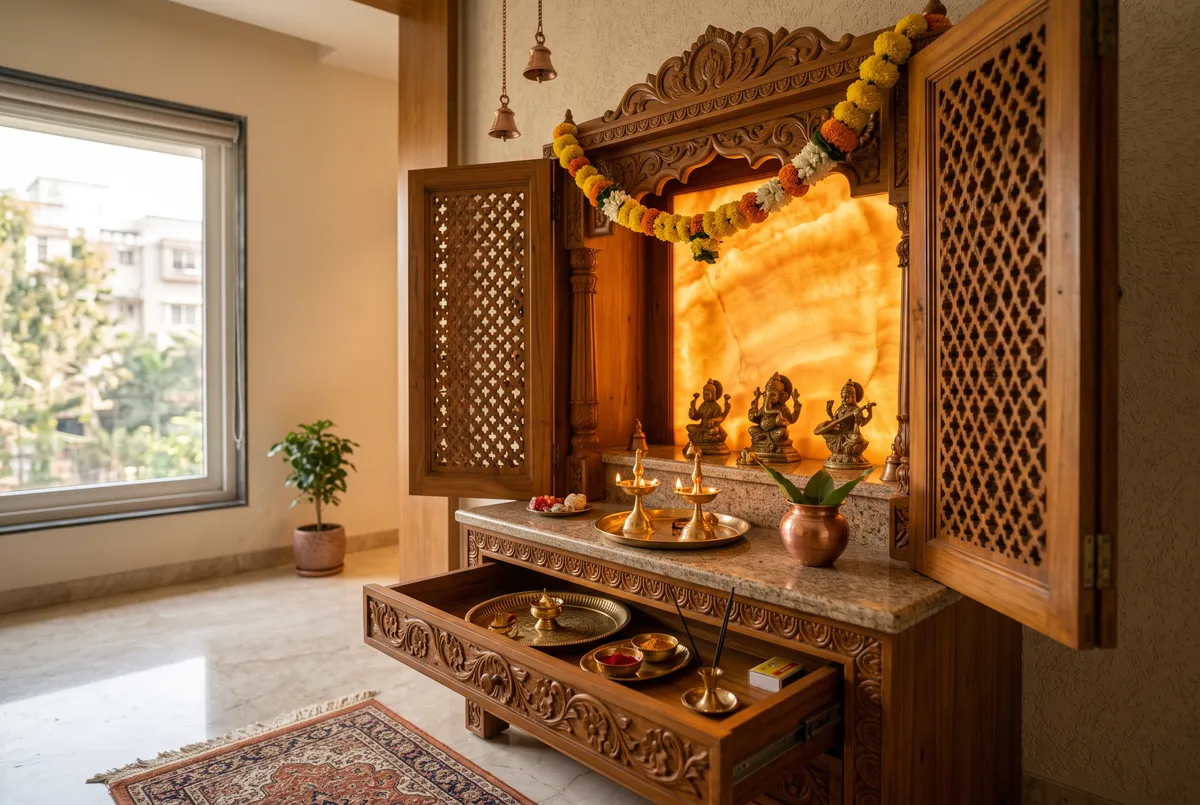
Which mandir style suits your home?
Quick answer
Match the mandir to your footprint: carved teak for a dedicated pooja room, jaali-fronted units where the shrine shares a living-room wall, backlit onyx for a glowing focal point, and a compact wall unit when floor space is scarce. All four keep symmetry around the deity and a defined threshold.
Match the mandir to the footprint you actually have: carved teak for a dedicated pooja room, a jaali-fronted unit where the shrine shares a wall with the living area, backlit onyx when you want a glowing focal point, and a compact wall unit when floor space is scarce.
Carved teak is the heirloom option — solid or veneered teak with hand- or CNC-carved pillars and a kalash crown, a material that deepens in colour with years of oil and incense. Jaali units use CNC-cut screens in 18 mm solid wood or HDHMR, semi-concealing the deity, hiding storage and letting lamplight scatter through the pattern. Backlit onyx places a translucent stone or composite panel behind the idols with warm LEDs concealed behind it, so the backdrop glows like a lamp itself.
Whatever the style, good mandir design for home settings keeps three constants: symmetry around the deity, a defined threshold — a step, arch or frame — and one honest material that signals ritual.
What is the best pooja unit design for a 2BHK?
Quick answer
A wall-hung unit 600–900 mm wide and 380–450 mm deep suits most 2BHKs: it uses no floor area, mounts at an 800–850 mm platform height, and closes behind jaali or fluted shutters. Position it so you face east or north, with at least one drawer below.
A wall-hung unit 600–900 mm wide and 380–450 mm deep is the best pooja unit design for most 2BHKs — it needs zero floor area, mounts at a comfortable 800–850 mm platform height, and closes behind jaali or fluted shutters when not in use.
Position it in the foyer or on a quiet living-room wall, ideally so you face east or north while praying. Bi-fold or pocket shutters matter more than they sound: an open mandir in a compact living room becomes visual clutter by evening, while shutters give the deity a defined, respectful enclosure. Keep at least 300 mm of clear height above the diya position, and never mount the unit directly over a TV or seating.
If you have a spare corner, an L-shaped corner mandir at 450 mm a side gives more platform for festival days. Either way, build in at least one drawer below — even the smallest shrine generates samagri.
Which materials handle diya heat and oil without ageing badly?
Quick answer
Stone at the flame, wood above it: the platform where lamps sit should be granite, marble or quartz, with BWP-grade (IS 710) plywood or HDHMR in teak veneer or PU for the carcass. Keep acrylic and paper-backed laminates away from the flame line.
Stone at the flame, wood above it. A diya flame burns at roughly 600–1,000 °C at the tip, and laminate within 300 mm of it will scorch, yellow or blister within months — so the platform where lamps actually sit should be granite, marble or quartz, with woodwork kept above and around.
Granite is the most forgiving base: sesame oil and ghee spills wipe off, and heat leaves no mark. Marble looks the part but is porous — seal it annually or oil rings become permanent. Add a small brass or stone diya plate so daily lamps never touch the main surface. For the carcass and shutters, use BWP-grade (IS 710) plywood or HDHMR with teak veneer or PU paint; PU handles incense residue and daily wiping far better than membrane finishes. Materials like these are why factory-built units can carry a 25-year modular warranty.
Skip acrylic sheets and paper-backed laminates anywhere near the flame line, and give the backdrop a stone or glass zone you can wipe weekly.
How do you plan storage for samagri?
Quick answer
Plan three zones: a 100–150 mm partitioned drawer under the platform for daily kumkum, agarbatti and camphor; a 200–250 mm drawer for the thali, bells and festival idols; and a wipe-clean pull-out for oil and ghee. Add a 6–10 mm upstand lip at the platform edge.
Give samagri three zones: a shallow partitioned drawer for daily items, a deeper drawer for occasional pieces, and a wipe-clean pull-out for oils. Daily ritual fails on friction — if the kumkum, agarbatti and matchbox are not within one arm's reach of the platform, they end up living on it.
The working spec: one 100–150 mm drawer directly under the platform with a removable partitioned tray for kumkum, haldi, chandan, vibhuti, cotton wicks and camphor in a sealed jar; one 200–250 mm drawer for the pooja thali, bells, festival idols and backup agarbatti packs; and a dedicated pull-out with a stone, steel or laminated base for oil and ghee bottles, because oil rings are the single most common damage inside pooja units. Line drawer bases with washable mats, never fabric.
Finally, add a 6–10 mm upstand lip at the platform edge — it stops rolling diyas and spilled oil from reaching the shutters below.
How should you light a pooja room for aarti?
Quick answer
Layer three warm sources at 2700–3000 K with CRI 90 or higher: a 12–24° accent on the deity on its own switch, a concealed LED glow behind jaali or onyx, and dimmable ambient light. Never cool white, and plan an exhaust path for incense smoke.
Layer three warm sources: a narrow-beam accent on the deity, a diffused glow behind or through the backdrop, and dimmable ambient light — all at 2700–3000 K with CRI 90 or higher, never cool white.
The deity accent is a 12–24° spotlight or recessed downlight aimed at the idols, wired to its own switch so it can stay on for evening lamps while the room lights are off. The glow layer is a concealed LED strip behind a jaali screen or onyx panel; run it through a dimmer, because the same shrine should feel gentle at a 5 am aarti and full at Diwali. Ambient light can come from the room itself or a small ceiling dome — a gypsum dome with concealed cove sits within the usual ₹65–180 per sq ft false-ceiling range, excluding 18% GST.
Plan ventilation alongside the lighting: agarbatti and camphor smoke needs an exhaust path, and never place a smoke detector directly above the mandir.
What does a pooja room cost in Bengaluru?
Quick answer
Typical Bengaluru ranges, all excluding 18% GST: a compact wall-hung pooja unit ₹30,000–80,000; a full-height mandir with jaali shutters and samagri storage ₹1–2.5 lakh; and a dedicated pooja room with carved doors, stone cladding and layered lighting ₹2.5–6 lakh.
Typical Bengaluru ranges, all excluding 18% GST: a compact wall-hung pooja unit runs ₹30,000–80,000; a full-height mandir unit with jaali shutters and samagri storage ₹1–2.5 lakh; and a dedicated pooja room with carved doors, stone cladding, a ceiling dome and layered lighting ₹2.5–6 lakh.
The spread comes from four decisions: board and finish (solid teak versus HDHMR with PU roughly doubles a unit's cost), stone selection for platform and backdrop, carving (hand-carved teak doors alone can cost more than an entire compact unit), and backlit onyx, which typically adds ₹25,000–60,000 depending on panel size. Within a full 2BHK interiors package of ₹8–22 lakh, a well-specified mandir usually sits at 3–5% of the budget.
Insist on an itemised BOQ that names the board grade, stone and hardware line by line — it is how we hold 95% quote accuracy, and it is how you compare any two quotes honestly.
Frequently asked
Get your real number
Share your floor plan — we turn these rates into a line-by-line proposal, usually within one working day.
Get an instant estimate