

Kitchens
Quartz vs Granite vs Marble: Choosing a Countertop for How You Actually Cook
For most homes that cook two or three Indian meals a day, quartz is the safest countertop: stain-resistant, seal-free, consistent. Granite wins if hot vessels land straight off the flame; marble belongs on a baking ledge or display island, never the main cooking run. The deciding factors are turmeric, acid, heat — and your honest maintenance appetite.
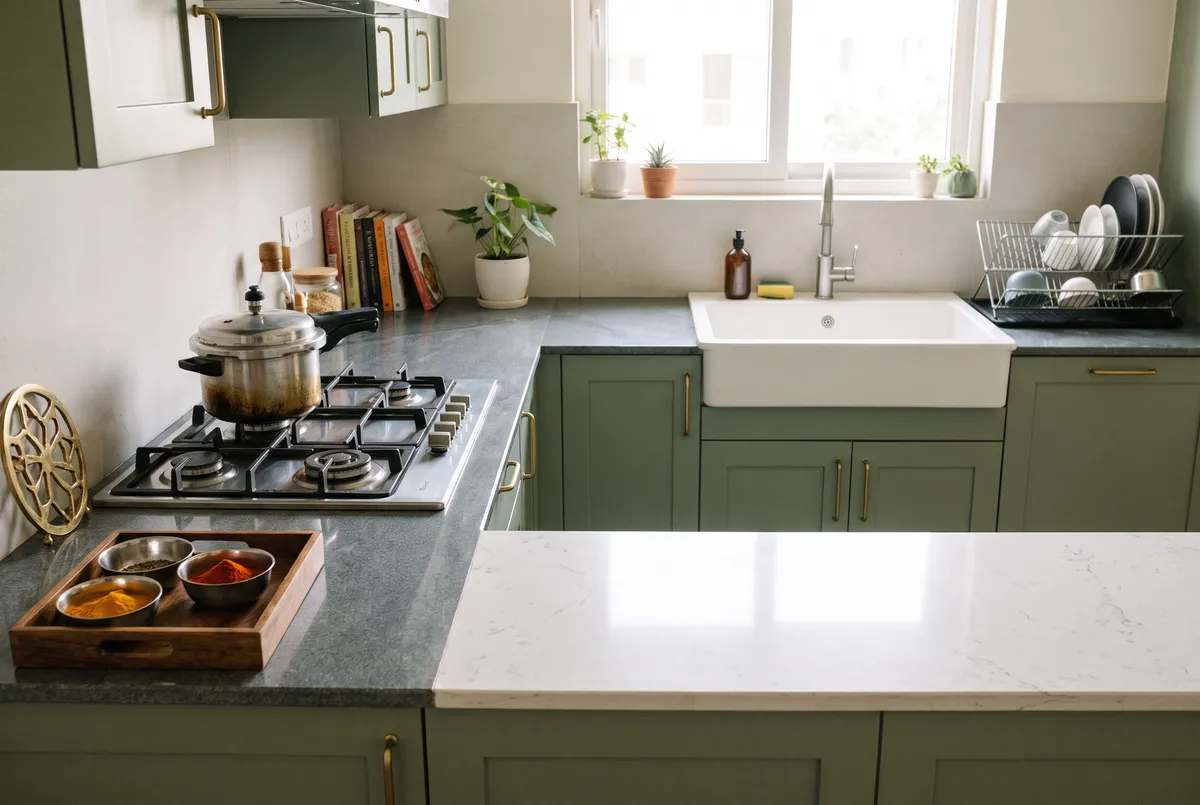
Which countertop suits the way most Indian families cook?
Quick answer
Quartz suits most Bengaluru kitchens cooking two or three meals a day: it shrugs off turmeric and oil, never needs sealing and looks consistent for years. Choose granite if hot vessels routinely land straight off the flame, and keep marble for a baking ledge or display island.
Quartz is the right answer for most Bengaluru kitchens that cook two or three meals a day: it shrugs off turmeric and oil, never needs sealing, and looks consistent for years. Choose granite if hot vessels routinely land straight off the flame, and keep marble for a baking ledge or display island — not the main cooking run.
That one-line verdict hides the real decision, which is not about stone at all. It is about your household: who cooks, how often the tadka splatters, whether the pressure cooker goes from burner to counter, and how much maintenance anyone will honestly do after month three. A countertop is a fifteen-to-twenty-year decision, and you touch it more than any other surface in the home.
The rest of this guide tests each stone against those realities — staining chemistry, heat behaviour, sealing schedules, edge profiles and indicative Bengaluru prices — so you can match the material to your kitchen, not to a showroom under flattering lights.
How does Indian cooking actually punish a countertop?
Quick answer
Three ways: pigment, acid and heat. Turmeric's curcumin is oil-soluble and wicks into porous surfaces within minutes; lemon, tamarind, curd and vinegar dissolve the calcite marble is made of; and a pressure cooker base off the flame sits well above 150°C, where quartz resin can scorch.
Three ways: pigment, acid and heat — and most 'best kitchen countertop India' advice tests for only one of them. Turmeric's colour compound, curcumin, is oil-soluble; carried in hot ghee or frying oil, it wicks into any porous surface and bonds within minutes. That is why a haldi stain survives scrubbing that removes everything else.
Acid is the quieter enemy. Lemon, tamarind, curd and vinegar all dissolve calcite — the mineral marble is made of — leaving dull 'etch' marks that no amount of cleaning removes, only re-polishing. Granite and quartz are largely acid-proof, which is half the reason they dominate working kitchens.
Heat is the third test. A pressure cooker base straight off the flame sits well above 150°C, the point where the polymer resin in engineered quartz can scorch or discolour. Natural granite, an igneous rock formed under far greater heat, does not care. Rank your own kitchen honestly against these three, and the right stone usually names itself.
When is granite the better buy?
Quick answer
Granite is the better buy when heat, budget and heavy daily use top your list: South Indian granites typically cost ₹180–450 per sq ft for material, excluding 18% GST, and take a hot kadai without flinching. At Mohs 6–7 it resists knife scratches, but needs an impregnating sealer every 12–24 months.
Granite wins when heat, budget and heavy daily use top your list. South Indian granites — Steel Grey, Black Galaxy, Kuppam Green — are quarried a few hours from Bengaluru, typically cost ₹180–450 per sq ft for material (excluding 18% GST), and take a hot kadai or cooker base without flinching. At Mohs hardness 6–7, it also resists knife scratches far better than marble ever will.
Its honest weaknesses: granite is mildly porous, so it needs an impregnating sealer roughly every 12–24 months, and lighter granites can hold oil and turmeric marks if spills sit overnight. Pattern is nature's choice, not yours — expect visible joints on long runs and slab-to-slab variation.
Practical picks: dark, densely patterned granites hide both stains and daily wear; a leathered or honed finish reduces glare under cabinet lights and shows fewer smudges than a mirror polish. For a hard-cooking household that would rather spend on cabinetry than counters, granite remains the sensible default.
When does quartz beat granite — and where does it fail?
Quick answer
Engineered quartz beats granite on everything except heat and price: roughly 90–93% ground quartz bound in polymer resin, effectively non-porous, and never in need of sealing. Its resin scorches above roughly 150°C so a trivet is non-negotiable, and material typically runs ₹350–1,200 per sq ft, excluding 18% GST.
In the quartz vs granite kitchen decision, quartz wins on everything except heat and price. Engineered from roughly 90–93% ground quartz bound in polymer resin, it is effectively non-porous — water absorption under 0.05% — so turmeric, oil and wine sit on the surface instead of soaking in. It never needs sealing, joints can be near-invisible, and the pattern you approve on the sample is the pattern that arrives.
Its failure modes are specific. The resin scorches above roughly 150°C, so a trivet for hot vessels is non-negotiable — one careless cooker placement leaves a permanent mark that cannot be polished out, unlike natural stone. Direct sunlight can also slowly yellow lighter resins, worth knowing for a counter under a west-facing window.
Material typically runs ₹350–1,200 per sq ft in Bengaluru (excluding 18% GST), depending on brand and pattern. If your household reaches for trivets by instinct, quartz is the lowest-maintenance working surface you can buy.
Are marble kitchen problems real, or designer fussiness?
Quick answer
They are real and chemical: marble is calcite, soft at Mohs 3–4 and etched by lemon, tamarind, curd and tomato, while oily turmeric wicks into its pores. It earns its keep as a dedicated 600–900 mm baking ledge or a low-use island, not the hob run.
They are real, and they are chemical. Marble is calcite — soft at Mohs 3–4 and dissolved by every acid an Indian kitchen produces: lemon, tamarind, curd, tomato. Each splash leaves a dull etch mark; each oily haldi spill wicks into the pores. Within a year, the hob run of a marble counter reads like a diary of everything cooked on it.
That does not make marble useless — it makes it a specialist. Its naturally cool surface is genuinely superior for rolling chapati and pastry dough, so a dedicated 600–900 mm baking ledge in marble is a luxury that earns its keep. It also works on a low-use island or breakfast counter where the worst it faces is a coffee cup.
If you love the look but cook hard, choose a white-veined quartz for the working run instead. You keep the calm, luminous surface and lose the anxiety — most marble kitchen problems are simply marble asked to do a job it was never built for.
What do countertops cost in Bengaluru, and do edge profiles matter?
Quick answer
Indicative material rates, excluding 18% GST: South Indian granite ₹180–450 per sq ft, imported granite ₹500–800, quartz ₹350–1,200, Indian marble ₹250–800 and Italian marble ₹900–2,500 plus. Edge profiles matter as well, and complex ones cost more machining time, so ask for edge pricing as its own line.
Indicative material rates, excluding 18% GST: South Indian granite ₹180–450 per sq ft, imported granite ₹500–800, quartz ₹350–1,200, Indian marble ₹250–800 and Italian marble ₹900–2,500 plus. Fabrication — hob and sink cutouts, edge work, installation — adds meaningfully, which is why a lump-sum 'counter included' quote deserves suspicion. In a typical ₹1.8–8L Bengaluru kitchen, the counter often lands at 8–15% of the total.
Edges change both the look and the life of the stone. An eased or pencil-round edge suits quartz's crisp minimalism and chips least; a bullnose is kindest at child height; a mitred apron drops the visible edge to 40–50 mm for that thick-slab look without paying for a thicker slab. Complex profiles on granite cost more machining time than a simple bevel, so ask for edge pricing as its own line.
At AesthetiX Spaces we itemise stone, fabrication and edge profile separately on the BOQ — it is how we hold 95% quote accuracy, and it lets you trade a costlier stone against a simpler edge with open eyes.
Frequently asked
Get your real number
Share your floor plan — we turn these rates into a line-by-line proposal, usually within one working day.
Get an instant estimate