

Trends
Interior Design Trends 2026: What Indian Homes Are Actually Adopting
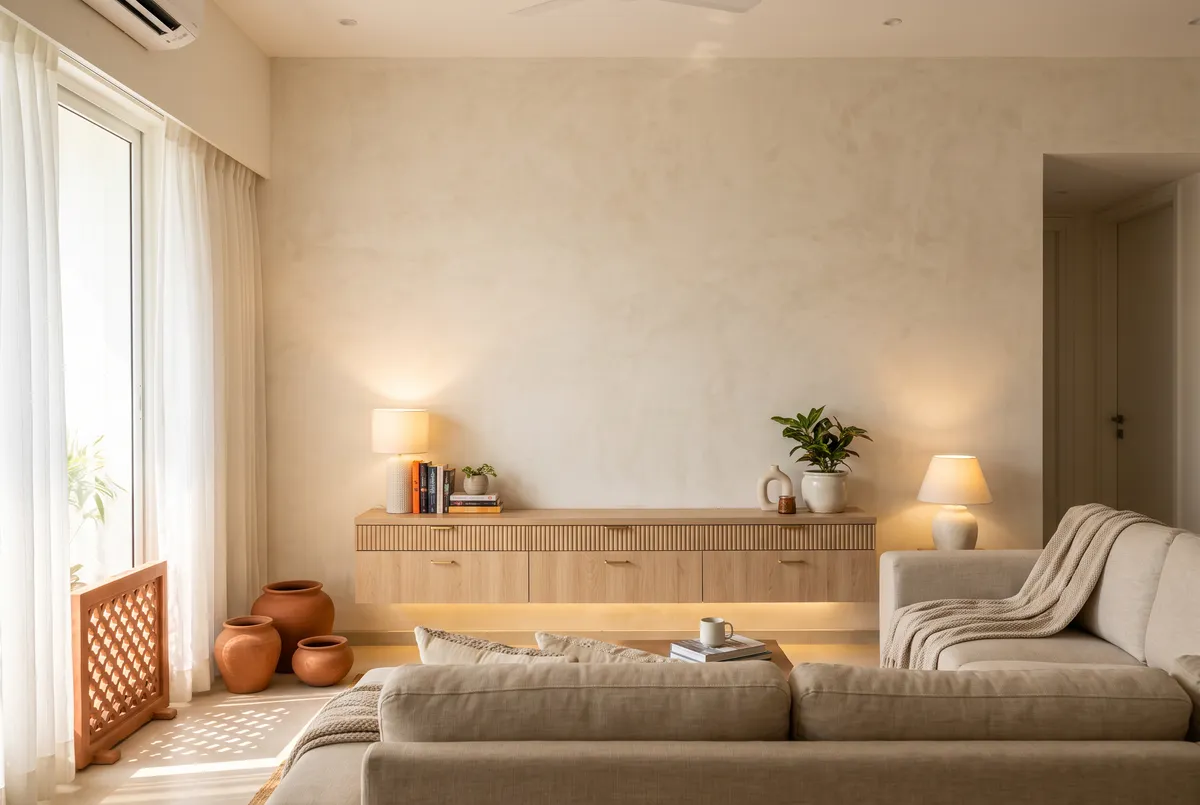
Indian homes in 2026 are settling on warm minimalism over stark white, fluted panels used as narrow accents, terracotta and lime textures, brushed quiet-luxury metals, and smart wiring planned from day one. The trends to skip — RGB cove ceilings, mirror walls, marble-print everything — photograph well but date within three years.
What are Indian homes actually adopting in 2026?
Quick answer
Five trends have genuinely crossed into Indian homes this year: warm minimalism, fluted panels used with restraint, terracotta and lime textures, brushed quiet-luxury metals, and smart wiring planned from day one. The common thread is longevity — trends live on replaceable surfaces while layout, storage and wiring stay quiet.
Five trends have genuinely crossed from mood boards into Indian homes this year: warm minimalism, fluted panels used with restraint, terracotta and lime textures, brushed quiet-luxury metals, and smart wiring planned from day one. Everything else you see on reels — colour-drenched ceilings, mirror walls, marble-print everything — is already ageing.
The common thread is longevity. After a decade of high-gloss laminates and grey-and-white schemes, homeowners are asking a sharper question: what will this look like in year eight? Interior design trends 2026 in India reward materials that wear in rather than wear out — wood tones, lime, linen, terracotta — and treat technology as infrastructure, not decoration.
The practical shift matters as much as the aesthetic one. Trend elements are moving to replaceable surfaces — paint, textiles, hardware, one accent wall — while the expensive, fixed layer (layout, storage, wiring, ceilings) stays deliberately quiet. That is the single most useful rule in this article.
Is warm minimalism replacing the all-white look?
Quick answer
Yes — the stark white-and-grey scheme is giving way to warm whites, oat, sand and mid-tone woods, with ivory or bone walls, light oak and teak veneers, and lighting at 2700–3000K. Metals have quietened too: brushed brass, champagne and gunmetal in matt PVD finishes.
Yes — the stark white-and-grey scheme that dominated Indian apartments for a decade is giving way to warm whites, oat, sand and mid-tone woods. Warm minimalism is the most adoptable of the modern interior trends because it is a temperature shift, not a spending shift: still fewer, better pieces, just no longer cold.
The palette is specific: ivory and bone whites on walls rather than brilliant white, light oak and natural teak veneers instead of high-gloss acrylics, and lighting locked at 2700–3000K warm white rather than the 4000K cool tubes most builders still fit. Textiles do the softening — linen, slubbed cotton, jute — so the architecture stays clean.
Metals have quietened too. Shiny rose gold and chrome are out; brushed brass, champagne and gunmetal in matt PVD-coated finishes are in — PVD holds its colour for years where cheap electroplating rubs off at the handle within one. Pick one metal family per room and repeat it in handles, taps and lights.
Have fluted panels peaked, or just grown up?
Quick answer
Grown up, not peaked: 2026 homes use fluted surfaces as an accent rather than wallpaper, and the profile has narrowed from chunky 40–50mm louvers to refined 20–25mm reeds. Keep flutes vertical, away from the hob line, and capped at one surface per room.
Grown up. Fluted surfaces are still the most requested detail in Indian interiors — but 2026 homes use them as an accent, not wallpaper. The floor-to-ceiling PVC louver wall behind every TV is the version that will date; a fluted band on a wardrobe or a bed-back panel is the version that will last.
The profile itself has matured: flute pitch has narrowed from chunky 40–50mm louvers to refined 20–25mm reeds, and the material has shifted from site-fixed PVC strips to factory-pressed laminate and veneer flutes that align perfectly at joints. Expect fluted laminate wardrobe shutters at roughly ₹1,400–2,200 per sq ft of shutter area, against ₹800–1,200 for plain finishes — both excluding 18% GST.
Placement rules: keep flutes vertical (they gather less dust than horizontal grooves), keep them away from the hob line in kitchens, and cap them at one surface per room.
Why are terracotta and lime textures suddenly everywhere?
Quick answer
Terracotta and lime add depth without adding objects, and suit Indian light and climate better than the grey-concrete look they replace. Limewash is vapour-permeable and naturally resists mould, but needs three to four thin coats and patch repairs rarely match — so use it on chosen accent walls.
Because they add depth without adding objects — and they suit Indian light and climate better than the grey-concrete look they are replacing. A limewashed wall shifts tone through the day; a flat emulsion wall cannot.
Lime has practical logic in Bengaluru. It is vapour-permeable, so damp-prone walls can breathe instead of blistering, and its high alkalinity (around pH 12 while curing) naturally resists mould. Application is the catch: limewash needs three to four thin coats by a practised hand, and patch repairs rarely match — so use it on chosen accent walls, not every surface.
Terracotta is arriving in three forms: jaali screens as room dividers that keep ventilation alive, cladding tiles on a single feature wall, and unglazed pottery as decor. All three age gracefully. The combination — lime above, terracotta accents, timber below — is essentially traditional Indian material logic returning with cleaner lines.
What does smart-home-by-default actually mean?
Quick answer
Smart-home-by-default means wiring discipline, not gadget shopping: a neutral wire at every switch point, two spare module spaces per switchboard, concealed conduits to curtain windows, one wired LAN point per floor, and 16A points. Lock these before drawings are frozen, and choose Matter-compatible devices.
It means wiring discipline, not gadget shopping. The 2026 standard is a home that can take automation later without breaking a single wall — and it costs very little if planned before civil work begins.
The checklist is short: a neutral wire at every switch point (most retrofit smart modules need one), two spare module spaces in each switchboard, a concealed conduit to every curtain window for motorised tracks, one wired LAN point per floor for a mesh node, and 16A points wherever an appliance might one day be scheduled. When you do buy devices, choose Matter-compatible ones so you are never locked to a single brand's app.
Timing is everything: these decisions must be locked before drawings are frozen, because they ride inside the false ceiling and wall chases. It is exactly why we freeze electrical layouts at the design stage at AesthetiX — our 30–45 day handover from design freeze only works because nothing is decided on site.
Which trends should you skip because they date fast?
Quick answer
Skip the elements whose main job is to photograph well — RGB colour-changing coves, mirror-and-gold glamour walls, marble-print laminate on every surface, arches cut into square apartments, full-wall charcoal 3D panels. The test: if removing it later means demolition, it must earn ten years.
Skip anything whose main job is to photograph well: multi-layer false ceilings with RGB colour-changing coves, mirror-and-gold glamour walls, marble-print laminate on every vertical surface, arches cut into square apartments, and full-wall charcoal 3D panels. Home decor trends in India now cycle in roughly three years on social media; each of these already reads as a date stamp.
The test is simple. If removing an element later means demolition — a profiled ceiling, a cladded wall — it must earn its place for ten years. If it is paint, fabric, hardware or a single panel, you can afford to play. Spend the fixed budget on layout, storage, ventilation and lighting positions; let trends live only in the replaceable layer.
Seeing is cheaper than regretting: insist on photo-real 3D views of every finish before committing, and an itemised bill of quantities so each trendy add-on has a visible price. At AesthetiX we hold quotes to 95% accuracy on an itemised BOQ precisely so a fad line-item can be cut without surprises.
Frequently asked
Get your real number
Share your floor plan — we turn these rates into a line-by-line proposal, usually within one working day.
Get an instant estimateKeep planning