

Living Spaces
Lighting in Layers: The Ambient-Task-Accent Method for Indian Homes
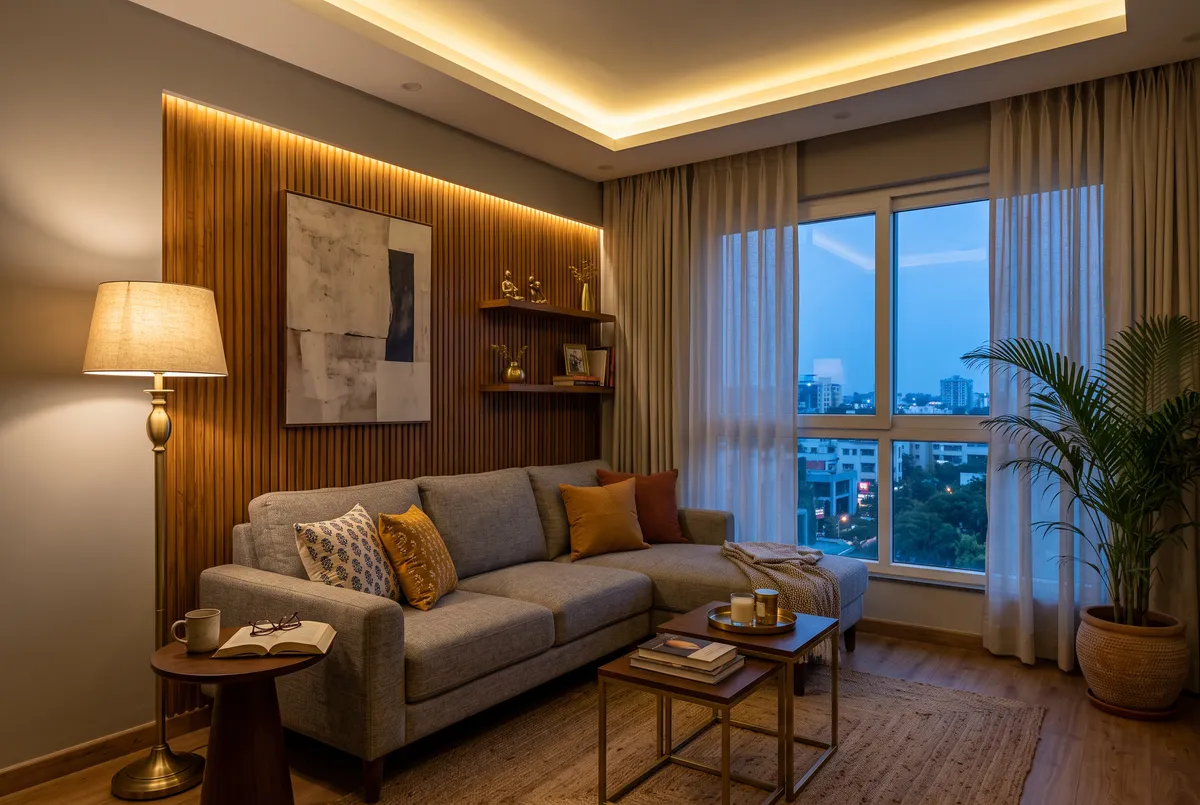
Layer three kinds of light — ambient for overall glow, task for work, accent for drama — instead of a grid of downlights. Keep living areas at 2700–3000K warm white, kitchens at 4000K, and wire each layer to its own switch. That single method fixes the commonest Indian lighting mistake: flat, over-bright rooms that flatter nobody.
What is the ambient-task-accent method?
Quick answer
The ambient-task-accent method layers three kinds of light: ambient fill that lets you cross the room, brighter task light where you read or chop, and low-wattage accent for drama on art or a wall. Plan roughly 50% of lumens ambient, 30% task and 20% accent, each separately switched.
Every well-lit room carries three layers doing three different jobs. Ambient light is the general fill — cove lighting, ceiling fixtures, or a spread of downlights that lets you cross the room safely. Task light is brighter and focused — the light you chop vegetables, read, or thread a needle under. Accent light is the lowest wattage and the highest drama: a picture light on art, a strip grazing a stone wall, a lamp warming a dead corner.
The method works because no single source can do all three jobs. A ceiling full of 9W downlights gives you airport-lounge brightness with zero mood; one warm lamp gives you mood but you cannot find your keys. As a working ratio, plan roughly 50% of lumens as ambient, 30% as task and 20% as accent, each on its own switch.
This ambient task accent lighting split is the entire secret of good home lighting design — one decision, repeated honestly, room by room.
Which LED colour temperature suits Indian homes?
Quick answer
Warm white, 2700K to 3000K, suits living rooms, bedrooms and dining, with neutral 4000K only where real work happens — the kitchen counter and study desk. Hold one temperature per room, and specify a CRI of 90 or above plus one brand and batch per room.
Warm white — 2700K to 3000K — for living rooms, bedrooms and dining; neutral 4000K only where real work happens, such as the kitchen counter and the study desk. Indian skin tones carry warm, golden undertones, and 2700–3000K light renders them beautifully; the 6500K 'cool daylight' tubes most of us grew up with flatten those same tones to grey and make 9 pm feel like office hours.
Colour temperature also sets the body's clock. After sunset a home should shift warmer, not brighter — the living room that hosts dinner should never share a kelvin with the workstation. And hold one temperature per room: a 3000K cove fighting 6500K downlights is the most visible sign of unplanned lighting in Indian homes.
Two specs matter as much as the LED colour temperature in a home: a CRI of 90 or above, so food, wood and skin read true; and one brand and batch per room, because even identically rated strips from mixed batches render visibly different whites.
How do the three layers work room by room?
Quick answer
Begin every room with ambient, add task where hands work, and spend accent on one focal point only: a 2700–3000K cove plus a reading lamp in the living room, 4000K under-cabinet strips in the kitchen, and warm dimmable ambient with independent bedside lights in bedrooms.
Start every room with ambient, add task where hands work, and spend accent on one focal point only. Living room: a 2700–3000K cove or ceiling fixture for fill, a reading lamp giving about 300 lux beside the main sofa, and an accent strip or picture light on one feature wall — never all four. Dining: one pendant hung 750–850 mm above the table does task and accent together.
The kitchen is the one room where task leads. Under-cabinet strips at 4000K sit directly over the counter and kill the shadow your own body throws from ceiling lights; ambient downlights only fill the walkway. Bedrooms want warm ambient on a dimmer, bedside lights switched independently on each side, and nothing aimed at the pillow.
Bathrooms need light at the face, not above it — vertical fixtures or a backlit mirror at 4000K beat one ceiling downlight that shadows every jaw. Pooja units and display niches are pure accent: small 3000K spots on their own switch, so they can glow alone at aarti time.
Where do profile lights actually earn their cost?
Quick answer
Profile lights earn their cost in four places: under kitchen wall cabinets, inside wardrobes with door-triggered switching, in a cove washing the ceiling, and grazing one genuinely good surface. In Bengaluru they typically cost ₹350–900 per running foot installed, excluding 18% GST — so every foot must justify itself.
Profile lights earn their cost in exactly four places: under kitchen wall cabinets, inside wardrobes with door-triggered switching, in a cove washing the ceiling, and grazing one genuinely good surface — stone, fluted panelling, rich veneer. Everywhere else they are decoration you will stop switching on within a month.
In Bengaluru, aluminium profile with a branded strip and driver typically costs ₹350–900 per running foot installed, excluding 18% GST; the cove that conceals it rides on a gypsum false ceiling at ₹65–180 per sq ft, also excluding GST. That is real money, so every foot must justify itself. Skip profiles above lofts, behind pelmets nobody faces, and in bedrooms already carrying a cove.
This is also where an itemised BOQ protects you. At AesthetiX Spaces, every running foot of profile, strip and driver is a separate line item — that discipline is how we hold 95% quote accuracy, against the lighting 'lump sum' that quietly swells after work begins.
How should you plan switching zones and circuits?
Quick answer
Give each layer its own switch: a living room needs a minimum of three circuits — ambient, task and accent — decided at the wiring stage. Add two-way switching between bedroom door and bedside, dimmable drivers on ambient circuits, and switchboards at 1,050–1,200 mm from finished floor level.
Give each layer its own switch — that is the whole principle. A living room needs a minimum of three circuits: ambient, task, accent. The moment they share one switch, you own a very expensive tubelight. Decide circuits at the wiring stage, because retro-cutting a finished false ceiling costs more than the fittings themselves.
Rules that hold across Indian homes: two-way switching between the bedroom door and the bedside, so nobody walks back across a dark room; dimmers on ambient circuits in living and bedrooms — specify dimmable drivers upfront, since ordinary LED drivers flicker on dimmers; the accent and pooja circuit near the room entry, so it can run alone in the evening; switchboards at 1,050–1,200 mm from finished floor level.
Plan scenes, not just switches. Because our design process is 3D-first, the evening scene, the TV scene and the full-bright scene are approved on the render before a single wire is laid — the cheapest possible moment to change your mind.
What are the commonest over-lighting mistakes?
Quick answer
The downlight grid is the commonest mistake: 15–20 recessed spots at even spacing over-light the centre of the room, do nothing for walls or faces, and lock you into all-or-nothing brightness. A 12 x 15 ft living room rarely needs more than 6–8 once a cove and lamps share the load.
The commonest mistake is the downlight grid: 15–20 recessed spots marching across the living room ceiling at even spacing. It over-lights the centre of the room, does nothing for walls or faces, and locks you into all-or-nothing brightness. A 12 x 15 ft living room rarely needs more than 6–8 downlights once a cove and lamps share the load.
The rest of the list is short but expensive: 6500K in every room; accents on all four walls so no wall is the focal point; no dimmers on ambient circuits; bare LED strip visible in an open cove instead of sitting inside a diffused profile; and a pendant hung so low it glares at seated eye level.
Run one test in every room: at night, switch on only the ambient layer. If you can hold a conversation or watch TV comfortably, the layer is right. If the room feels like a showroom, remove fittings — good light is felt, never counted.
Frequently asked
Get your real number
Share your floor plan — we turn these rates into a line-by-line proposal, usually within one working day.
Get an instant estimate