

Choosing & Process
What Interiors Cost Across the Sarjapur Corridor: Locality-by-Locality (2026)
From Bellandur's builder-basic towers to Whitefield's fifteen-year-old townships, the Sarjapur corridor is one interiors market with one price card. A 2BHK runs ₹8–14 lakh essential and a 3BHK ₹12–18 lakh wherever you live on the stretch, excluding GST. Here is what actually moves the number, locality by locality — and the quoting patterns that should make you pause.
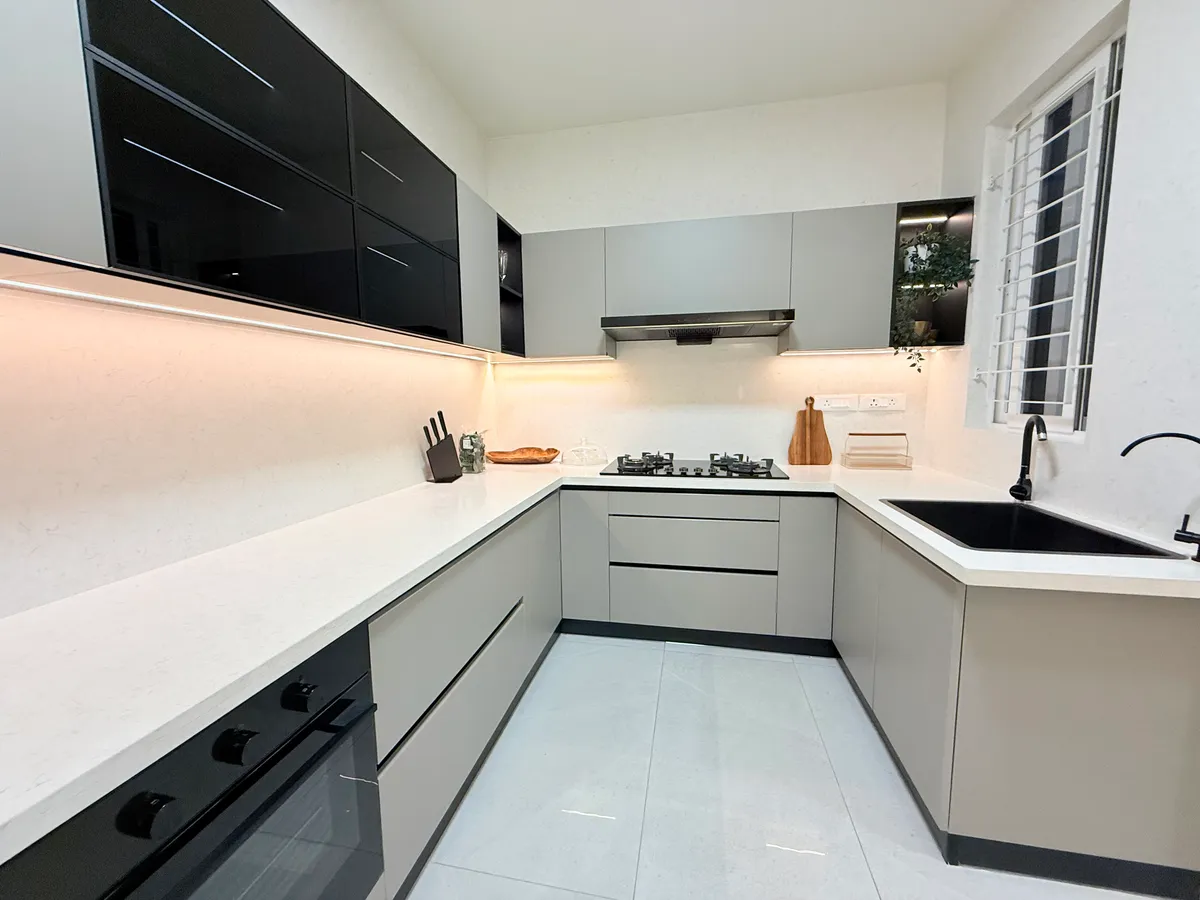
Is interior cost really different in each locality along the Sarjapur corridor?
Quick answer
No. The corridor is one interiors market. A 2BHK costs ₹8–14 lakh essential and ₹14–22 lakh premium whether it stands in Bellandur, Whitefield or Electronic City, excluding 18% GST. Home type, scope and specification move the number; the pin code does not.
Search for interior costs and you will find a separate page for every pin code on the corridor, each implying that Bellandur has one economics and Whitefield another. The published market numbers say otherwise. Full-home interiors in Bengaluru typically run ₹1,400–2,500 per sqft for an essential scope and ₹2,500–4,000+ per sqft for premium materials, on carpet area and excluding 18% GST — and those ranges are city-wide. The Sarjapur corridor, from Electronic City through HSR, Bellandur, Sarjapur Road and Varthur up to Whitefield, sits inside them as a single market.
What genuinely differs from locality to locality is the housing stock, and therefore the typical brief. Bellandur hands over builder-basic apartments to Outer Ring Road tech owners who want a full fit-out. Whitefield's older townships are crossing the ten-to-fifteen-year mark and need full renovations rather than patch-ups. HSR Layout is independent homes, builder floors and duplexes where no two floor plates are alike. Those briefs carry different scopes, and scope changes the bill — but a 3BHK at a given specification costs what it costs, street by street.
The practical consequence: compare quotes on specification and scope, never on locality. If two firms quote the same 3BHK differently, the explanation should live in the BOQ line items, not in the address.
What do 2BHK and 3BHK interiors typically cost, locality by locality?
Quick answer
Corridor-wide, a 2BHK typically runs ₹8–14 lakh essential to ₹14–22 lakh premium and a 3BHK ₹12–18 lakh essential to ₹18–30 lakh premium, excluding 18% GST. The same market ranges apply from Sarjapur Road to Whitefield; only the typical brief changes.
The table below puts the corridor's main localities against the typical Bengaluru market ranges for a full 2BHK (1,000–1,200 sqft) and 3BHK (1,400–1,700 sqft) — modular kitchen, wardrobes, false ceiling, painting and loose furniture included. Read the ranges as identical on purpose: that is the finding, not an omission.
The middle column is where the real differences live. A possession-wave locality like Varthur — where Prestige Lakeside Habitat alone releases thousands of apartments and villaments — generates fresh builder-basic fit-outs, usually the full scope from bare shell. A renovation brief in an established Whitefield township or an HSR builder floor adds dismantling and civil work on top of the same woodwork scope. Electronic City's compact, efficiency-first homes tend to land in the essential band by choice, not constraint.
| Locality | Dominant homes & typical brief | 2BHK typical range | 3BHK typical range |
|---|---|---|---|
| Sarjapur Road | Mid-possession-wave mix — villa streets like Rainbow Drive, established blocks like Springfields, newer towers like Bren Champions Square | ₹8–14L / ₹14–22L | ₹12–18L / ₹18–30L |
| Whitefield | Townships like Prestige Shantiniketan and Palm Meadows at the 10–15-year full-renovation mark; new possessions at Brigade Cosmopolis | ₹8–14L / ₹14–22L | ₹12–18L / ₹18–30L |
| Bellandur | Builder-basic apartments in large communities — Embassy Pristine, Adarsh Palm Retreat, Sobha Dream Acres — needing full fit-outs | ₹8–14L / ₹14–22L | ₹12–18L / ₹18–30L |
| HSR Layout | Sector 1–7 independent homes, builder floors and duplexes; renovation-heavy, no two floor plates alike | ₹8–14L / ₹14–22L | ₹12–18L / ₹18–30L |
| Electronic City | Compact, efficient 2–3BHKs (Ajmera Infinity, Shriram Summitt, Concorde Manhattans); function-first, essential-band briefs | ₹8–14L / ₹14–22L | ₹12–18L / ₹18–30L |
| Varthur / Kasavanahalli | Large-scale new possessions — Prestige Lakeside Habitat, Sobha Dream Acres, Bren Celestia — mostly bare-shell fit-outs | ₹8–14L / ₹14–22L | ₹12–18L / ₹18–30L |
Ranges shown as essential / premium. Typical Bengaluru market ranges, excluding 18% GST. The ranges are corridor-wide by design — home type, scope and specification decide where within them your project lands.
Why do average project bills look higher in Whitefield and HSR than in Electronic City?
Quick answer
Because the housing mix differs, not the rates. Whitefield and HSR carry more villas, independent homes and full renovations — larger scopes that bill more — while Electronic City and Bellandur are dominated by compact apartment fit-outs. Same rate card, different briefs.
A villa or 4BHK interior typically costs ₹20–35 lakh essential and ₹35–60 lakh+ premium for a 2,400–4,000 sqft home, excluding 18% GST — with staircase joinery, double-height treatments and full-home ceilings that no flat carries. Whitefield's villa enclaves like Palm Meadows and HSR's independent homes and duplexes push more projects into that bracket, so the locality's average bill climbs. A 4BHK flat of similar bedroom count, by contrast, lands around ₹18–30 lakh essential to ₹30–45 lakh premium, precisely because it skips the architectural extras.
Renovation adds a second layer. Whitefield's integrated townships are crossing ten to fifteen years, where kitchens, wardrobes and ceilings are due full replacement rather than a patch-up; HSR's typical project is a renovation of a home with structural quirks, terraces and a one-off floor plan. Electronic City sits at the other pole: first homes in efficient towers, bought by families who want maximum function per rupee — hardworking kitchens and wardrobes, essential-band finishes, no showroom excess.
None of this means Whitefield is an expensive locality and Electronic City a cheap one. Put the same 1,500 sqft 3BHK specification in either place and the market maths is identical — roughly ₹13–19 lakh essential, up to ₹28 lakh premium, excluding GST. The averages diverge; the rate card does not.
If not the pin code, what actually moves the number?
Quick answer
Three levers: home type and size, scope, and specification. Roughly ₹1,000–1,500 per sqft separates essential from premium — carcass grade, shutter finish, hardware brand, ceiling design and countertop material. A villa adds staircase and double-height scope that no flat carries.
Home type sets the floor. The ladder runs from ₹4.5–7 lakh for an essential 1BHK through ₹8–14 lakh for a 2BHK and ₹12–18 lakh for a 3BHK to ₹20–35 lakh+ for a villa — all excluding 18% GST. Within any home, scope is the second lever: a modular kitchen alone spans ₹1.8–3.5 lakh basic to ₹4.5–8 lakh premium, wardrobes run ₹800–2,200 per sqft of shutter area, and false ceilings ₹65–180 per sqft depending on design level. Add or drop rooms, lofts and ceiling coverage and the total moves in lakhs — with the address unchanged.
Specification is the third lever, worth roughly ₹1,000–1,500 per sqft between the essential and premium bands. The money goes into identifiable places, which is exactly why they should be identifiable in your BOQ:
- Carcass grade — BWR versus BWP plywood; BWP costs 15–25% more but survives sink leaks and steam
- Shutter finish — laminate at the essential end, acrylic or PU at the premium end
- Hardware brand — local fittings versus Hettich, Hafele or Blum; quality cup hinges are cycle-tested for 80,000–200,000 operations
- Ceiling and lighting design — plain peripheral gypsum versus multi-level, profile-lit work
- Countertop material — the last big swing item in a kitchen's price
Should you trust a firm that quotes differently by locality for the same specification?
Quick answer
Treat it as a warning sign for identical specification. Documented complaint patterns show quotes escalating 20–67% between first estimate and final BOQ, and measurement-basis tricks alone can multiply billable area 2.5–3x. A fixed, itemised BOQ with the pricing method written down is the defence.
Consumer-forum records from 2021–2026 document a repeating pattern at large firms: sales pressure in the first meeting, a booking amount taken — sometimes before any quotation exists — and then the quote inflating 20–67% between first estimate and final BOQ, with industry sources putting typical hidden-cost creep at 15–25%. Lump-sum, locality-flavoured pricing is fertile ground for this, because a number not anchored to line items can silently absorb substitutions: a 16mm carcass where 18mm was assumed, 3.5mm back panels instead of 6mm, 0.8mm edge banding passed off as 2mm, unbranded hinges billed as imported hardware.
The measurement basis is the other trap. Some quotes price wardrobes and units on shutter (front) area; others count every panel surface — a 2.5–3x difference in billable square footage for the same physical unit. Both methods can be legitimate, but only if the method is written into the quote. A firm that shades its numbers by pin code while leaving the measurement basis and material specifications vague is asking you to compare the incomparable.
The structural fix is a fixed, itemised BOQ where every line carries a specification and a price, GST shown as a separate line at 18% for turnkey work. It is also why we publish a 95% quote-accuracy commitment: the final bill stays within 5% of the signed BOQ, or the difference is absorbed. Whatever firm you choose, that written anchor — not the locality story — is what protects your budget.
What corridor practicalities should you budget for besides the interiors themselves?
Quick answer
Society rules, mainly. Most Karnataka communities permit work 9 AM–6 PM Monday to Saturday with no Sundays, renovation approvals take 15–30 days, and refundable deposits of ₹10,000–50,000 are common. Build both the approval window and the working-hours calendar into your plan.
The corridor's large gated communities — from Adarsh Palm Retreat to Prestige Shantiniketan — run on association bylaws, and Karnataka guidance is consistent: work hours of 9 AM to 6 PM, Monday to Saturday, with no Sundays or holidays; renovation approvals that take 15–30 days to clear; and refundable deposits of ₹10,000–50,000 before work begins. None of this changes what your interiors cost, but the approval window belongs in your timeline and the deposit in your cash plan — especially in possession-wave communities where the association is processing many applications at once.
Possession pressure is the corridor's other reality. In Varthur, Kasavanahalli and Bellandur, owners typically take a builder-basic shell with rent still running on the old home, so the schedule matters as much as the price. This is where written commitments earn their keep: we hand over most homes in 30–45 days from design freeze, with a ₹2,000/day delay penalty in the signed work agreement. Ask any firm you shortlist for its equivalent in writing — and ask where its supervision actually sits, since our own Experience Centre is on Sarjapur Road at Yamare, minutes from the corridor's centre of gravity but 40-odd minutes from Whitefield or Electronic City in traffic. Distance is manageable; unwritten dates are not.
Frequently asked
Get your real number
Share your floor plan — we turn these rates into a line-by-line proposal, usually within one working day.
Get an instant estimate